
Yuma County Court Records After a Jail Arrest
Yuma County is in Colorado's 13th Judicial District. After an arrest, the custody path may involve Yuma County Sheriff's Office, Washington County Justice Center, and then Yuma County Combined Court. The court record is the public case record created through the judicial system, not the same thing as the sheriff's booking entry. A person can appear on a jail roster before a formal charge is filed, and a court case can remain visible after the person bonds out, transfers, or is no longer listed as an inmate.
The local court contact is Yuma County Combined Court, 310 Ash Street, Suite L, Wray, CO 80758. The court information number is 970-592-6120, and the listed email is yumacountycourts@judicial.state.co.us. The official court page says appearances are in person unless otherwise ordered. Filed charges and hearings are searched through the Colorado Judicial Branch docket search, while custody and booking details belong with Yuma County jail inmate records. Booking photos are a separate issue covered under Yuma County jail mugshots.
How to Find Yuma County Court Records After an Arrest
Start with the Colorado Judicial Branch docket when a Yuma County arrest has moved into a scheduled court event. The docket search is public and can show date, time, party name, case number, hearing type, location, appearance type, and courtroom. It is not the official record copy, and the Judicial Branch access guide cautions that online data may omit some cases or case types. When online data conflicts with paperwork, the correction path is the court that created the record.
- Open the Colorado Judicial Branch docket search.
- Set County to Yuma County, then add a Date Range because the docket requires a date filter and at least one other filter.
- Use party-name fields if the case number is unknown. If jail paperwork lists a case number, split it into year, case class, and sequence.
- Read the docket row for date, time, hearing type, location, appearance type, and courtroom.
- Request official filings from Yuma County Combined Court or use the court-record search route identified by Colorado agencies when a docket row is not enough.
The official docket search is shown in the manifest as a successful source image: Colorado Judicial Branch dockets provide the search fields used to find court records after a Yuma County arrest.
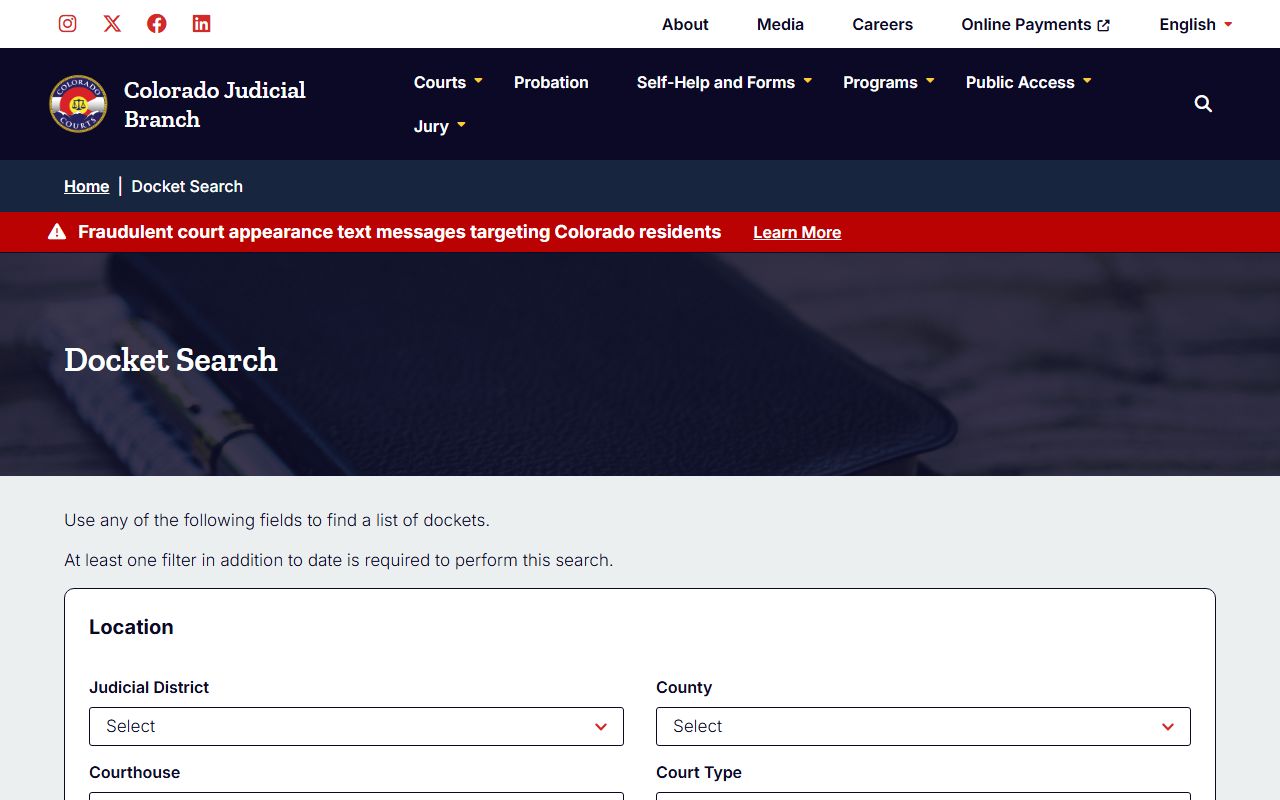
The docket screen supports several search paths, which matters when a recent arrest does not yet have a known case number.
| Search Field | Type | Required | Notes |
|---|---|---|---|
| Judicial District | Dropdown | Optional | Colorado's district list includes the district serving Yuma County. |
| County | Dropdown | Optional | Select Yuma County for local court records after a jail arrest. |
| Courthouse | Dropdown | Optional | Includes Yuma County Courthouse. |
| Court Type | Dropdown | Optional | Both, County, or District. |
| Date Range | Dropdown/date | Required with another filter | Options include Today, 1 Week, 1 Month, 3 Months, 6 Months, or Specific Date. |
| Case Number Parts | Text/dropdowns | Optional | Use 4-digit year, case class such as CR or M, and case sequence. |
| Party Name | Text | Optional | Use first and last name for individual party search. |
| Attorney Search | Text/radio controls | Optional | Search by attorney name or bar number when relevant. |
How Charges Become Court Records After an Arrest
Booking charges are arrest allegations entered by law enforcement. The formal court record begins when a charging document is filed or when court activity is scheduled. In Yuma County criminal cases, the 13th Judicial District Attorney reviews law-enforcement reports and may file charges. The DA is not the jail, and the sheriff is not the prosecutor. That separation explains why a jail entry may list one charge while the court record later shows amended, reduced, or different filed charges.
| Document | Who Uses It | What It Does | Yuma County Search Note |
|---|---|---|---|
| Complaint | Prosecutor or law-enforcement/prosecutor process | Often starts a criminal case and lists alleged offenses. | May appear early in county or district court records. |
| Information | Prosecutor | Formal prosecutor-filed charging document after review. | Controls filed charges when entered in the case file. |
| Indictment | Grand jury | Grand-jury charging document, less common for routine local arrests. | Look to the court record and prosecutor filings, not the jail roster. |
The 13th Judicial District Attorney is the prosecution office serving Yuma County. Discovery or DA-file questions are routed to the District Attorney's Office under applicable rules, while court-file questions go to the clerk or official court-record search channels.
The DA source helps place filed charges in the correct office: prosecutor records are different from jail custody records and different from court docket rows.
Charge Status in Court Records After an Arrest
Charge status changes as the case moves from arrest to hearing, plea, trial, dismissal, or sentencing. A status field is not a conviction by itself. It describes the current position of a charge or case event in the court record.
| Status | Meaning | Practical Reading |
|---|---|---|
| Pending | The charge or case remains active. | Check the next hearing date and court location. |
| Amended | The prosecutor changed the charge. | Compare the new charge with the original booking allegation. |
| Reduced | The charge changed to a lesser offense. | Often appears after plea negotiations or review. |
| Dismissed | The charge ended or was removed by court/prosecutor action. | Dismissal is not the same as automatic sealing. |
| Deferred | The case or sentence is held open under conditions. | Later outcomes depend on compliance and court orders. |
| Convicted / pled guilty | A final guilt finding or plea exists. | Use final court disposition, not arrest language. |
Bond and Release After a Yuma County Arrest
Bond is tied to the court's release order and the holding facility's processing rules. The Yuma sheriff jail page links a Colorado money-bond rights document, and Washington County Justice Center publishes bond-rights language and an online Genesis eBonds link. The posted Washington County language says bond fees, booking fees, and other debts do not have to be paid to secure release on a money bond; the payor pays the bond amount. It also says bond payments are made out to the holding county, not the incarcerated person.
| Bond Type | How It Works | Release Caveat |
|---|---|---|
| Cash bond | Full amount is posted as required. | Another hold can still block release. |
| Surety bond | A licensed bail agent posts bond for a fee or collateral. | Not every case or hold is surety eligible. |
| Personal recognizance / PR bond | Release based on promise to appear and obey conditions. | Violations can trigger revocation or warrant. |
| No-bond hold | Release is not allowed at that stage. | The court or holding agency must resolve it. |
| Detainer or agency hold | Another agency asks the jail to keep custody. | Local bond may not release the person. |
Confirm bond eligibility through the jail and court before paying. A person arrested in Yuma County may be housed in Washington County, have a hearing in Yuma County Combined Court, and remain held because of another county warrant, probation or parole hold, federal hold, ICE detainer, or no-bond warrant.
Warrants That Lead to a Jail Arrest and Court Records
No official Yuma County online active-warrant list was located in the reviewed sources. For a local warrant question, call Yuma County Sheriff's Office at 970.332.4805 during office hours or contact Yuma County Combined Court at 970-592-6120 for bench warrants or court-case warrants. The Colorado Judicial Branch docket may show court activity, but it is not a statewide warrant database.
A warrant arrest can create a new booking even when the underlying case is older. A person may appear in jail records under a recent booking while the court case number reflects an earlier year. Warrants can also explain why a person posts bond on one matter but remains in custody on another agency hold.
Charges vs. Convictions
A charge is an allegation filed or maintained in a court case. A conviction is a final guilt finding or guilty plea. Court records after a jail arrest often show charges long before they show outcomes, so read the status and disposition fields before drawing conclusions.
| Issue | Charge | Conviction |
|---|---|---|
| Stage | Accusation or filed count after arrest. | Final plea or finding of guilt. |
| Proof | Filed based on probable cause and prosecutor review. | Resolved under the criminal burden of proof or plea process. |
| Record Meaning | May be pending, amended, reduced, or dismissed. | Reflects the outcome unless later vacated, sealed, or otherwise changed by court order. |
| Where to Verify | Docket, charging document, court clerk. | Disposition record, judgment, sentence, or clerk confirmation. |
Sealed vs. Expunged Court Records After Arrest
Colorado provides sealing forms and self-help materials through the Judicial Branch. CBI notes that CCIC arrest and criminal records remain unless sealed by court order. The public-access result is not the same for every record type, and an agency social-media removal request is not the same as a court sealing order.
| Issue | Sealed | Expunged |
|---|---|---|
| Public visibility | Restricted from ordinary public access when a court order applies. | Used in narrower contexts; eligibility depends on Colorado law and case type. |
| Law-enforcement access | May remain available to certain agencies under law. | Can be more limited, depending on the statute and order. |
| Process | Use Colorado Judicial Branch sealing forms or court procedure. | Use the specific Colorado procedure that applies to the record. |
| Yuma County contact | Yuma County Combined Court for court orders; YCSO or Washington County for agency records after an order. | Verify with the court or custodian before assuming removal from every system. |
Public Access to Court Records After a Jail Arrest
Colorado separates general public records from criminal justice records. CORA covers many general public records, but criminal justice records are governed by the Colorado Criminal Justice Records Act, C.R.S. 24-72-301 et seq. Court access also has its own rules and limits. The Colorado Judicial Branch access guide states that online court data is not the official court record and may omit cases or case types.
The Colorado Judicial Branch public-records access guide is the relevant statewide source for court-record boundaries.
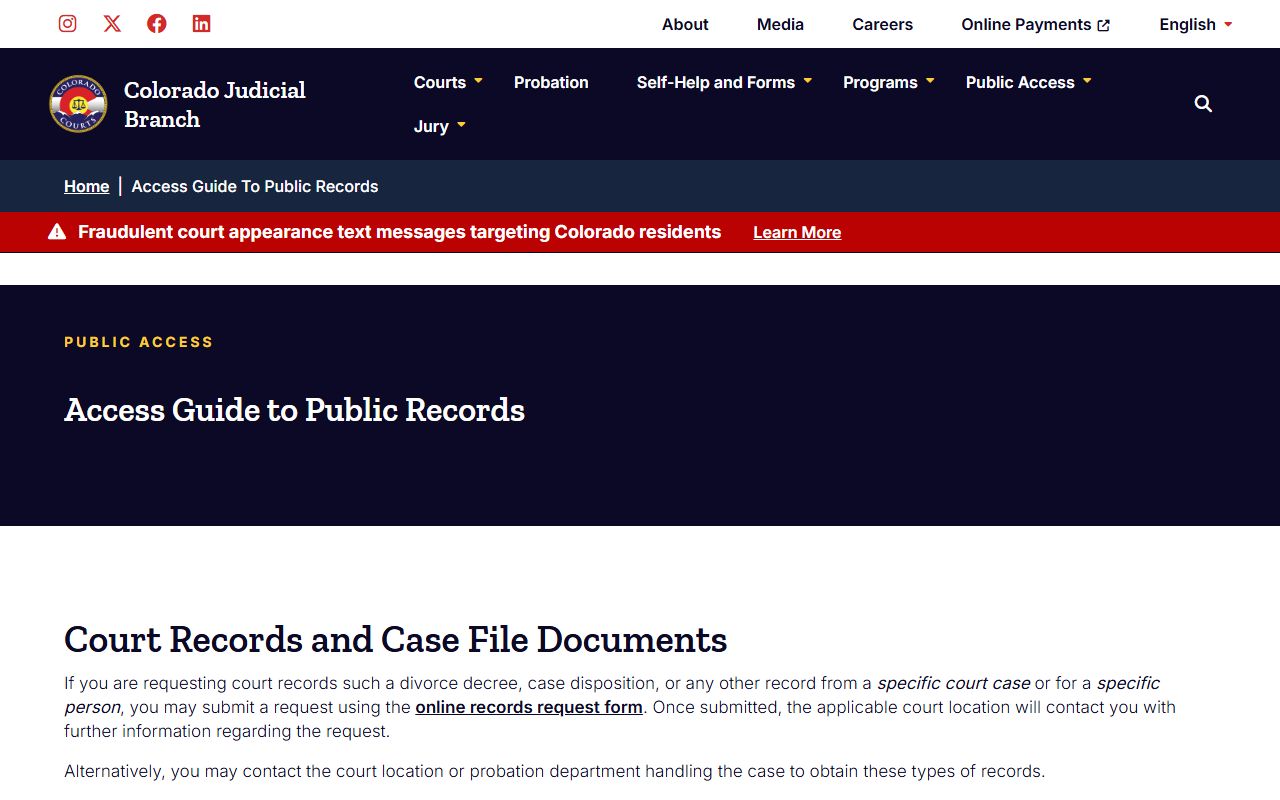
Use the guide's limits when a docket search is incomplete: court records, jail records, prosecutor records, and criminal-history records are not interchangeable.
Use limits: Do not use casual court or jail lookups for employment, tenant screening, credit, insurance, or another FCRA-covered decision. Use legally compliant background-check channels for those purposes.